
Most lifters train hard and still stop progressing. The effort is there. The plan is not.
Muscle does not grow because you suffered. It grows because you asked it to do more than before. That single idea is progressive overload. It sits underneath every program that works.
The problem is how people use it. They add weight until they cannot, and then they get stuck. Adding weight is one tool. You have several.
This guide shows you how to apply them, how fast to progress, and what to do when the bar stops moving.
What Progressive Overload Actually Means

Progressive overload means gradually increasing the demand placed on a muscle so it is encouraged to adapt. That is the whole definition.
In weight training, it usually shows up as:
- More weight
- More reps
- More sets
- More training volume over time
The label does not matter. The rising demand does.
If the demand never increases, there is less reason for the muscle to continue adapting. It maintains what it has rather than continuing to improve.
How the Muscle Actually Adapts
Training creates a stimulus. One of the main drivers of muscle growth is mechanical tension on the muscle fibers.
You recover from that stimulus. Then, if the training dose was appropriate, you come back a little stronger.
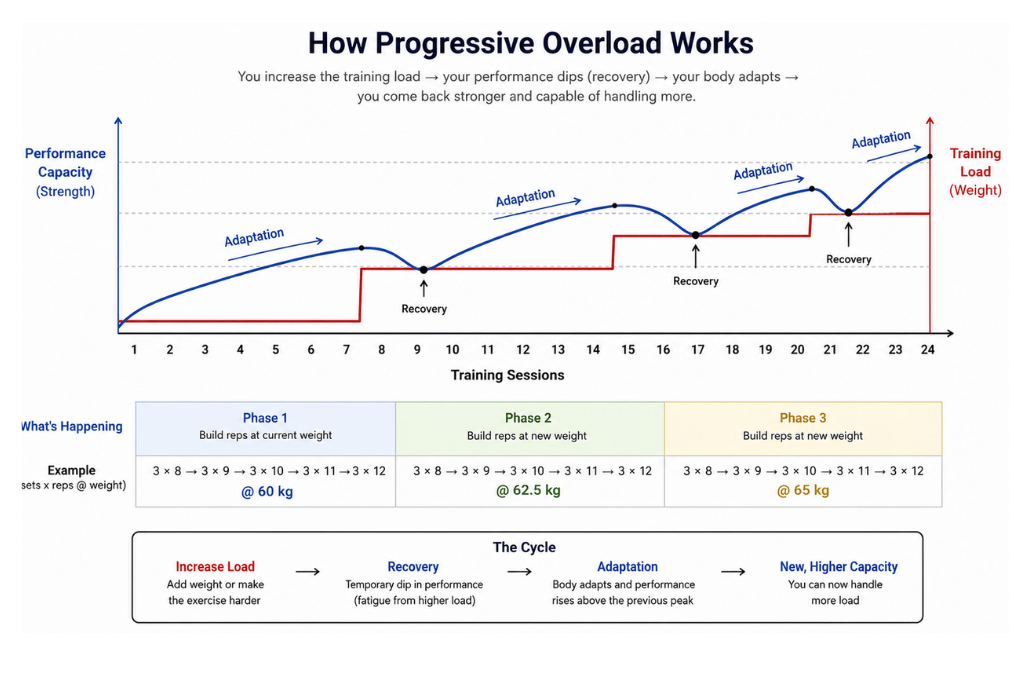
Stimulus → Recovery → Adaptation
That loop is the engine.
Progressive overload keeps gradually increasing the training stimulus so the body continues to have a reason to adapt.
The key is finding the right increase
- Too small a change: You may simply maintain your current level.
- Too large a change: You can create excessive fatigue and make recovery harder.
- The right change: You provide enough stimulus to continue progressing without overwhelming recovery.
Aim for the smallest increase that still allows you to make progress.
How progressive overload works: Each increase in training demand is followed by recovery and adaptation to a higher level.
The Levers You Can Pull
Adding weight is the obvious lever. It is not the only one.
You can:
- Add reps at the same weight.
- Add a set and increase your weekly volume.
- Train a muscle more often.
- Use a fuller range of motion.
- Slow the lowering phase to increase time under tension.
Each of these can increase the demand placed on your muscles.
Volume Matters
Volume matters more than most people think.
Research suggests that increasing weekly resistance-training volume can contribute to greater muscle growth, although the benefits vary between individuals and can become smaller as volume continues to increase.
Adding a set every week or two can sometimes be smoother than continually forcing a heavier bar.
For a closer look at how weekly sets can influence muscle growth, this detailed guide to training volume breaks it down.
You Do Not Have to Add Weight
Here is the part that frees people up:
Reps count as overload, too.
For example:
- Last week: 60 kg × 3 sets × 8 reps
- This week: 60 kg × 3 sets × 9 reps
The weight stayed the same, but you performed more work.
A 2022 study compared progressing through load increases with progressing through repetition increases. Both approaches produced similar muscular adaptations under the conditions studied.
So when the weight will not move, add reps instead.
You are not necessarily stuck. You have simply switched levers.
How Fast to Progress, and How Often
How quickly you can add weight or volume depends on where you are in your training.
Beginners
A beginner can often progress almost every session because early improvements in strength can happen quickly.
Intermediate Lifters
An intermediate lifter may progress every week or two.
Advanced Lifters
An advanced lifter may take several weeks or longer to make a meaningful improvement.
A simple rule can keep you honest:
- Pick a rep range.
- Work toward the top of that range.
- Use clean form.
- When you can reach the top while still having about two reps left in the tank, consider adding weight or a set.
That two-reps-in-reserve approach provides a useful way to gauge effort.
It also gives you flexibility on days when you are tired or have not fully recovered. On those days, reducing the weight rather than forcing a poor-quality set is often the better choice.
What Happens When You Stop Progressing?
Progression is not only about adding more.
You cannot climb forever. Sooner or later, fatigue can build faster than you recover.
You may notice:
- Your lifts stop progressing.
- Warm-ups feel unusually heavy.
- Your normal working weights feel harder.
- Recovery takes longer.
- Your performance starts declining.
That is a signal, not necessarily a wall.
The Role of a Deload
One option is a deload.
You can take an easier training week by:
- Reducing your number of sets.
- Temporarily lowering the weight.
- Reducing overall training volume.
- Focusing on controlled, high-quality repetitions.
Some lifters reduce their training volume substantially or decrease the load by around 10–20% during a deload. There is no universal timeline for when you need to deload. It depends on your training program, experience, fatigue levels, and recovery.
A planned easy week is not lost progress. It can help manage fatigue so you can return to productive training.
The American College of Sports Medicine also emphasizes a planned, progressive increase in training demand rather than simply training harder without a structured approach
Progressing While You Are Cutting
Cutting changes the equation.
In a calorie deficit, recovery can become more difficult, and adding weight to your lifts may become harder.
That does not mean you should stop trying to overload.
It means you change the target.
During a Cut, Focus On:
- Maintaining your strength.
- Using similar weights and reps when possible.
- Keeping your technique consistent.
- Managing fatigue.
- Continuing to provide your muscles with a training stimulus.
If you can continue using the same weights and reps you used before, that can be a positive sign that you are maintaining your training capacity while losing body fat.
If you do make progress, expect smaller improvements rather than personal records across every exercise.
Clean reps beat chasing heavy records when recovery resources are limited.
Progress on a cut often looks like simply keeping what you built.
A Real Eight-Week Bench Press Example
Theory is tidy. Training is not.
Here is a realistic block using the bench press.
You start at 60 kg for three sets and work within an 8–12 rep range.
This is called double progression.
How Double Progression Works
- Start with a manageable weight.
- Gradually increase your reps.
- Stay within your chosen rep range.
- Once you reach the top of the range with good form, increase the weight.
- Allow the reps to reset.
- Repeat the process.
Eight-Week Example
| Week | Weight | Reps per Set |
|---|---|---|
| 1 | 60 kg | 8 |
| 2 | 60 kg | 9 |
| 3 | 60 kg | 10 |
| 4 | 60 kg | 11 |
| 5 | 60 kg | 12 |
| 6 | 62.5 kg | 8 |
| 7 | 62.5 kg | 9 |
| 8 | 62.5 kg | 10 |
The weight has increased, but so has your ability to perform more work at different loads.
Tracking What Matters
You cannot progress what you do not measure.
Memory is generous in the gym. Everyone thinks they did more than they actually did.
Write down the weight and reps for your main lifts during every session.
At a minimum, track:
- Exercise
- Weight
- Reps
- Sets
- Date
That is the foundation.
Track Your Estimated 1RM
For another useful signal, estimate your one-repetition maximum (1RM) from your working sets.
Watch that number over months, not days.
For example:
100 kg × 5 reps → 100 kg × 8 reps
That represents real improvement, even though the weight itself never changed.
A bench press 1RM calculator can do the math for you. Enter your weight and reps, then compare the estimate across the training block.
The trend tells you much more than a single workout.
The Bottom Line
Progressive overload is not a trick you add to training. It is one of the fundamental reasons resistance training works.
Keep it simple:
- Pick a few key lifts.
- Choose an appropriate rep range.
- Add reps until you reach the top of the range.
- Add a small amount of weight and start again.
- Add a set when appropriate.
- Deload before fatigue becomes a major problem.
- On a cut, focus on maintaining what you have built.
- Track the trend, not the day.
Do that with patience and consistency, and you can continue building muscle and strength for years.