
The fitness world used to draw a hard line between strength athletes and endurance athletes. Powerlifters didn’t run. Marathon runners didn’t touch a barbell. But that line is disappearing and the data proves it.
The Rise of Hybrid Fitness
Hybrid training combines strength work with endurance conditioning in a single program. It’s not new in concept, but it’s new in scale. Events like HYROX, CrossFit competitions, and obstacle course races now attract hundreds of thousands of participants worldwide who need both capabilities on race day.

- HYROX alone has grown from a niche European event to a global series with races on every continent. The format eight 1km runs alternated with eight functional workout stations demands that athletes be competent runners and strong enough to push heavy sleds, carry loaded farmer’s handles, and complete 100 wall balls without collapsing.
- The athletes who excel aren’t specialists. They’re generalists who’ve learned to balance competing physical demands. And the growth of this movement shows no signs of slowing down HYROX participation has roughly doubled every season since its launch.
What the Data Shows About Hybrid Athletes
Analyzing performance data from large-scale hybrid events reveals some counterintuitive findings about what actually predicts success.
- Pure runners struggle on the gym floor: Athletes with fast 10K times often lose significant time on strength-heavy stations like the sled push or farmer’s carry. Running fitness doesn’t transfer to loaded movement as well as most people assume. The sled push alone can create 5–10 minute gaps between athletes who otherwise run at similar paces. That single station can be the difference between a podium finish and a mid-pack result.
- Strong athletes fade on later runs: Conversely, athletes with impressive gym numbers often see their running pace degrade sharply after the first few stations. Carrying heavy loads and pushing sleds taxes the legs in ways that compound over subsequent kilometers. By the sixth or seventh run segment, the drop-off can be dramatic sometimes 30 seconds per kilometer slower than their opening pace.
- The sweet spot is consistency: Data from HyCoach shows that the best overall finishers aren’t the fastest at any single station they’re the most consistent across all of them. Low variance across segments correlates strongly with better finishing times, more so than having one exceptional strength. The lesson is clear being “pretty good” at everything beats being great at one thing and terrible at another.
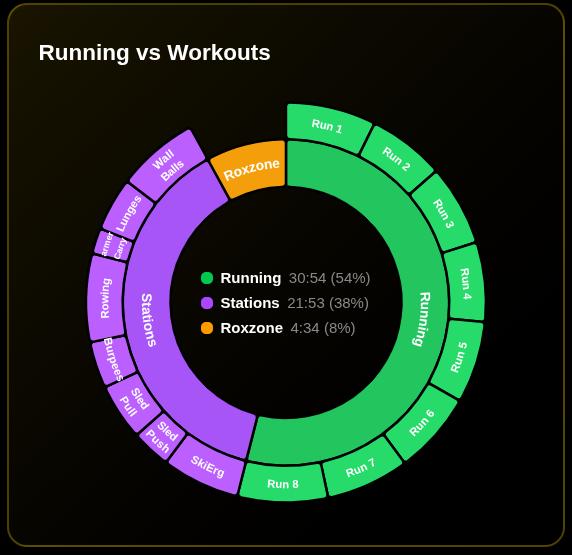
- Transitions matter more than you think: The moments between activities racking weights, walking to the next station, mentally preparing for the next effort add up across a full race. Elite competitors treat transitions as a trainable skill, not dead time. Shaving 10 seconds off each transition in an eight-station race saves over a minute without any fitness improvement at all.
How to Structure Hybrid Training
Building a hybrid program means accepting trade-offs. You won’t set powerlifting PRs while training for a sub-40-minute 10K. But you can get remarkably good at both with smart programming.
- Prioritize your weakness: If you’re a runner, dedicate three sessions per week to strength work focusing on the exact movements you’ll face in competition. If you’re from a strength background, add structured running with progressive distance and pace targets. The goal isn’t to become elite at your weakness, just to remove it as a bottleneck.
- Simulate race conditions regularly: Once a week, combine running and strength in a single session. Run 1km, then immediately perform a functional movement for time. Repeat for 3–4 rounds. This teaches your body to produce force under cardiovascular stress the exact demand of hybrid racing. It also builds the mental toughness of switching between modalities when you’re already tired.
- Use data to guide adjustments: After each race or benchmark workout, analyze your splits. Tools like HyCoach break down performance by station and run segment, showing exactly where you’re strong and where you’re bleeding time. Train accordingly rather than defaulting to what you enjoy doing.
- Manage recovery deliberately: Hybrid training creates more systemic fatigue than single-discipline programs. Monitor your running pace trends and strength output week to week. If both are declining simultaneously, you’re doing too much volume scale back before you burn out or get injured. Quality sessions beat junk miles every time.
The Competitive Edge
Hybrid fitness rewards the athlete who prepares intelligently. The era of “just run more” or “just lift heavier” is over for anyone competing in multi-discipline events. The data is clear: balanced preparation, guided by objective performance analysis, produces better results than brute-force volume in any single area.
The athletes who embrace this approach and use data to refine it are the ones standing on podiums.