Water bottle? Check. Phone and wallet? Packed.
But the second you clip in, your legs feel like they’re still asleep. Stiff hips and cold muscles from sitting all day can make those first 10 minutes feel tough. This quick 5-minute routine gets everything firing so you ride strong right away. Do it before you clip in.
Why a Quick Warm-Up Matters Before Every Ride
When you jump straight onto the bike with cold muscles, your heart rate spikes too quickly, and your legs feel heavy and sluggish. To get all the benefits from cycling, your system needs a few minutes to adapt and handle the intensity without an overwhelming shock to your system.
Instead of forcing cold muscles to adapt instantly to heavy pedaling, a warm-up gently switches on your body. Spend just 5 minutes, and your body:
● Increases muscle temperature and blood flow: It gently primes your cardiovascular system, ensuring your heart rate rises smoothly rather than spiking uncomfortably the moment you start pedaling.
● Switches on your quads, glutes, hamstrings, hip muscles, and core: It wakes up your primary cycling muscles, ensuring they are fully firing and ready to share the workload evenly.
● Increases hip, ankle, and spine mobility: It lubricates your joints and unlocks your range of motion, allowing for a much smoother, more fluid, and efficient pedal stroke.
● Reduces the risk of injury from sprains, strains, and overuse: It provides vital protection where cyclists need it most—particularly the knees and lower back. Because cyclists stress their knees similarly to runners, protect them long-term with your warm-up.
● Triggers cognitive and neuromuscular activation: It sharpens the communication between your brain and your muscles, helping you shake off mental fog and get in the zone much faster.
The 5-Minute Pre-Ride Warm-Up Routine
Complete all five exercises in sequence for 5 minutes. Move with control and breathe. No equipment required.
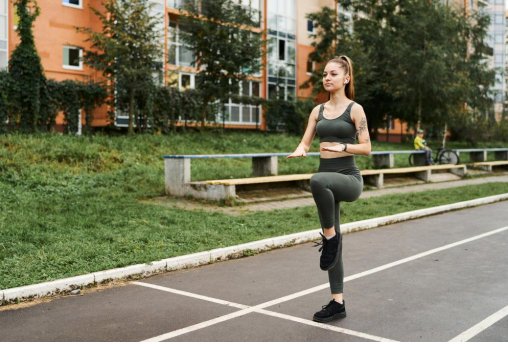
1. High Knees March (60 seconds)
Start with your feet hip-width apart. Lift one knee toward the sky and swing your opposite arm forward. Lower your foot and repeat on the other side. Engage your core. Primes leg drive and rhythm for the bike.
Why it matters: This motion directly mimics the top of your pedal stroke, actively priming your hip flexors, quads, and core rhythm.
Pro Tip: Avoid leaning backward as your knee goes up; keep your spine tall and proud to ensure your core does the stabilizing work.
2. Front-to-Back Leg Swings (30 seconds per leg)
Hold onto a support for balance. Swing one leg forward and back with a soft knee. Perform 15–20 swings per leg. Loosens hips and hamstrings for full pedal range.
Why it matters: This dynamic movement stretches and contracts the hamstrings and quads simultaneously, unlocking full lower-body extension.
3. Side-to-Side Leg Swings (30 seconds total)
Keep holding onto a support. Swing one leg across the body then out to the side. Do both sides evenly. Opens hips for better handling and power.
Why it matters: Cycling is a purely linear (sagittal) movement, but the muscles that stabilize your hips (your abductors and adductors) operate laterally. Opening them up improves bike handling and power distribution.
4. Standing Torso Twists (45–60 seconds)
Stand with your feet shoulder-width apart and your knees slightly bent. Twist your upper body side to side, arms swinging naturally. Keep your hips stable and move from the core. Aim for 20–30 twists. Prepares midsection and back for riding.
Why it matters: Cyclists often forget that the upper body and spine bear a massive structural load, especially during climbs or out-of-the-saddle sprints.
5. Arm Circles + Shoulder Rolls (45 seconds)
Make large forward circles with straight arms for 15 seconds, then backward. Follow with slow shoulder rolls. Relaxes the upper body for good posture on the bars.
Why it matters: Relieves residual tension in the neck, upper back, and shoulders, preventing the dreaded “handlebars slouch” and keeping your chest open for optimal lung capacity.
That’s the full 5 minutes. You’re now ready to ride strong from the very first stroke.
Build the Habit
The hardest part of a warm-up routine isn’t the movements themselves. When you’re eager to get moving, it’s easy to skip straight to the ride.
To make this a seamless habit, try anchoring it to a routine you already follow. Go through these quick movements while you wait for your GPS unit to lock onto a satellite, or right after you fill your water bottles. By pairing the warm-up with an existing pre-ride step, you remove the mental effort of deciding whether or not to do it.
Give this routine a shot before your very next session. Your knees, hips, and lungs will thank you, and you’ll hit the road or trainer feeling strong right out of the gate. Safe riding!